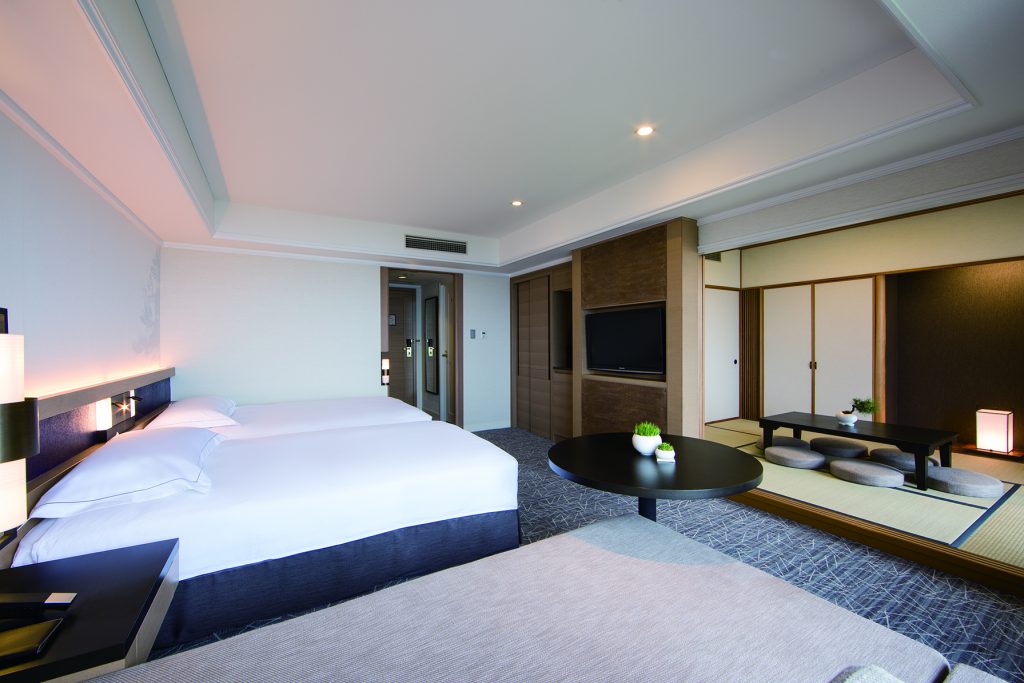
Hilton Odawara Resort & Spa stands on a hill overlooking Sagami Bay. It has a vast site of more than 180,000 m2, and has 163 guest rooms, mainly twin types, all with ocean views. In addition to restaurants, banquet halls, and large hot spring baths, this is a resort hotel with a full range of sports activities such as fitness, swimming pools, and golf driving ranges. The hotel was established in February 2004 and will mark the 15th anniversary in 2019. The hotel has been renovating its building since 2015.
The interior of the guest rooms was designed with pine leaves, and it was finished with a Japanese taste as imagined by foreigners including the installation of a bracket (wall lighting) in the motif of the local specialty from Odawara Sumitomo Lantern. In July, the company is expanding and redesigning its lounge in both men's and women's spaces on large public bath, and is working to increase the value of its facilities. In this large-scale renovation, the company also reviewed air-conditioning systems in conjunction with the renovation of guest rooms. Yusuke Takahashi Assistant Chief Engineer of Mr. Yusuke Takahashi, the deputy general manager of Hilton Odawara Resort & Spa Facilities Management Department, explains the reasons for the review.
"Approximately 20 years have passed since the building was newly constructed. In the two-pipe heating and cooling system(2-pipe fan coil system) that was initially installed, there were no issues with the air conditioning period in mid-summer and the heating period in mid-winter, but there were issues in the mid-spring and autumn.
During this period, the difference between cold and warm weather during the daytime was so large that heating and cooling could not be switched. During such periods, however, the weather was greatly influenced, and complaints were made that the rooms were hot on sunny days and cold on cloudy or rainy days. In addition, there were essentially no international customers, partly because it was a public facility, but after rebranding the hotel, the ratio of foreigners has increased.
Some of our foreign customers, even in the middle of the winter, walk through the lobby wearing a tank top. We feel the differences in their feelings of temperature. Even in winter, customers increasingly prefer air conditioning because of the heat in their rooms. I remember that there were 40 to 50 such complaints about air-conditioning every year. In particular, it seems that Japan's climate has changed recently, and its desire for air-conditioning is on the rise."
PAFMAC manufactured and sold by Nippon PMAC Co., Ltd. was singled out to respond to the need for such air condition needs. Our priority was on enabling cooling and heating throughout the year without involving large-scale construction.
PAFMAC is a system which can make it cooling and heating free, while reusing the existing two pipes for cooling and heating system. The two pipe system is a system in which hot and cold water produced in a heat source room such as a boiler room are carried to the guest room through pipes spread throughout the building and cold and warm air is sent to the room via fan coils installed in the room. Cooling is possible when cold water is flowing in the piping, and heating is possible when hot water is flowing.
PAFMAC incorporates a heat pump that enables both heating and cooling with chilled/hot water in the air conditioning unit called fan coil. Actual installation requires only removing and replacing the existing fan coil unit with a PAFMAC, which means that no large-scale construction is required and there is almost no noise.
"Our hotel is proceeding with all renovation work without suspension of business. As for guest rooms, we divided the 3 to 12 floors into 2 floors for 2 months each to construct taking a total of one year. The renovation of air-conditioning systems is a simple construction process that simply replaces two pipe fan coil unit of fan coil units with PAFMAC, so I think it is also advantageous to proceed with the construction even when the hotels are in operation. There was no problem as long as the window of the guest room under construction was closed even on the day of the wedding ceremony. On the floor where PAFMAC was introduced, complaints about the heat and cold were drastically reduced, and the work of staffs in the accommodation division, such as the delivery of blankets, was also reduced."